Showing posts with label Greek alphabet. Show all posts

Thursday, February 21, 2013

Modern calligraphy

Modern calligraphy ranges from functional hand-lettered inscriptions and designs to fine-art pieces where the abstract expression of the handwritten mark may or may not compromise the legibility of the letters (Mediavilla 1996). Classical calligraphy differs from typography and non-classical hand-lettering, though a calligrapher may create all of these; characters are historically disciplined yet fluid and spontaneous, at the moment of writing (Pott 2006 and 2005; Zapf 2007 and 2006).

Modern calligraphy

Modern calligraphy

Modern calligraphy

Modern calligraphy


Modern calligraphy

Calligraphy continues to flourish in the forms of wedding and event invitations, font design/typography, original hand-lettered logo design, religious art, announcements/graphic design/commissioned calligraphic art, cut stone inscriptions and memorial documents. It is also used for props and moving images for film and television, testimonials, birth and death certificates, maps, and other works involving writing

Source: Wikipedia


Thursday, February 7, 2013

Persian calligraphy

After initiation of Islam in the 7 th century, Persians adapted the Arabic alphabet to Persian and developed the contemporary Persian alphabet. Arabic alphabet has 28 characters and Iranians added another four letters in it to arrive at existing 32 Persian letters. Around one thousand years ago, Ibn Muqlah and his brother created six genres of Iranian calligraphy, namely "Tahqiq", "Reyhan", "Sols", "Naskh", "Toqih" and "Reqah". 

Persian calligraphy

Persian calligraphy

Persian calligraphy

Persian calligraphy

Persian calligraphy

Persian calligraphy

Persian calligraphy


These genres were common for four centuries in Persia. In 7th century (Hijri calendar), Hassan Farsi Kateb" combined "Naskh" and "Reqah" styles and invented a new genre of Persian calligraphy, named "Ta'liq". Eventually in the 14th century, "Mir Ali Tabrizi" combined two major scripts of his time i.e. Naskh and Taliq and created the most attractive Persian Calligraphy style, "Nas’taliq". In past 500 years Iranian calligraphy called Nastaʿlīq Nastaʿlīq (also anglicized as Nastaleeq; in Persian: نستعلیق nastaʿlīq) is one of the main script styles used in writing the Perso-Arabic script, and traditionally the predominant style in Persian calligraphy.

Japanese calligraphy


The Chinese roots of Japanese calligraphy go back to the twenty-eighth century B.C., to a time when pictographs were inscribed on bone for religious purposes. When this writing developed into an instrument of administration for the state, the need for a uniform script was felt and Li Si, prime minister in the Chinese dynasty of Qin, standardized a script and its way of being written. He sanctioned a form of script based on squares of uniform size into which all characters could be written from eight strokes. 
Japanese calligraphy

Japanese calligraphy

Japanese calligraphy

Japanese calligraphy


Japanese calligraphy

Japanese calligraphy

Japanese calligraphy


There only three main tools you need for simple calligraphy, they are: a long calligraphy brush, a cup of black ink and some paper, those three materials are the most important of calligraphy. I think calligraphy one the most beautiful forms of art and fonts, they are very unique in they own way, I also think  that calligraphy can express who you are, your feelings and emotions on paper.

Saturday, December 22, 2012

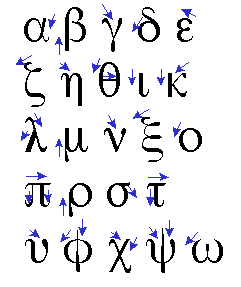
Font - Greek alphabet


The Greek alphabet is the script that has been used to write the Greek language since the 8th century BC.It was derived from the earlier Phoenician alphabet, and was in turn the ancestor of numerous other European and Middle Eastern scripts, including Cyrillic and Latin.Apart from its use in writing the Greek language, both in its ancient and its modern forms, the Greek alphabet today also serves as a source of technical symbols and labels in many domains of mathematics, science and other fields.

Article Source: Wikipedia