Showing posts with label Calligraphy Alphabets. Show all posts

Thursday, February 21, 2013

Modern calligraphy

Modern calligraphy ranges from functional hand-lettered inscriptions and designs to fine-art pieces where the abstract expression of the handwritten mark may or may not compromise the legibility of the letters (Mediavilla 1996). Classical calligraphy differs from typography and non-classical hand-lettering, though a calligrapher may create all of these; characters are historically disciplined yet fluid and spontaneous, at the moment of writing (Pott 2006 and 2005; Zapf 2007 and 2006).

Modern calligraphy

Modern calligraphy

Modern calligraphy

Modern calligraphy


Modern calligraphy

Calligraphy continues to flourish in the forms of wedding and event invitations, font design/typography, original hand-lettered logo design, religious art, announcements/graphic design/commissioned calligraphic art, cut stone inscriptions and memorial documents. It is also used for props and moving images for film and television, testimonials, birth and death certificates, maps, and other works involving writing

Source: Wikipedia


Thursday, February 7, 2013

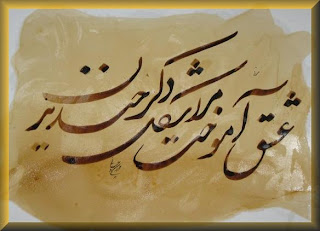
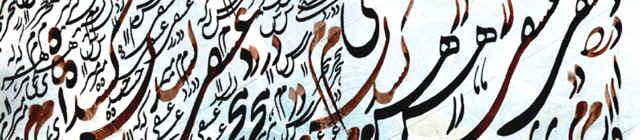
Persian calligraphy

After initiation of Islam in the 7 th century, Persians adapted the Arabic alphabet to Persian and developed the contemporary Persian alphabet. Arabic alphabet has 28 characters and Iranians added another four letters in it to arrive at existing 32 Persian letters. Around one thousand years ago, Ibn Muqlah and his brother created six genres of Iranian calligraphy, namely "Tahqiq", "Reyhan", "Sols", "Naskh", "Toqih" and "Reqah". 

Persian calligraphy

Persian calligraphy

Persian calligraphy

Persian calligraphy

Persian calligraphy

Persian calligraphy

Persian calligraphy


These genres were common for four centuries in Persia. In 7th century (Hijri calendar), Hassan Farsi Kateb" combined "Naskh" and "Reqah" styles and invented a new genre of Persian calligraphy, named "Ta'liq". Eventually in the 14th century, "Mir Ali Tabrizi" combined two major scripts of his time i.e. Naskh and Taliq and created the most attractive Persian Calligraphy style, "Nas’taliq". In past 500 years Iranian calligraphy called Nastaʿlīq Nastaʿlīq (also anglicized as Nastaleeq; in Persian: نستعلیق nastaʿlīq) is one of the main script styles used in writing the Perso-Arabic script, and traditionally the predominant style in Persian calligraphy.

Eastern Asian calligraphy


First of all, the word ‘Calligraphy’ in Greek means beauty and writing and to express signs in the most beautiful way. Calligraphy in Asia is incredibility famous, people there not only use it as a art style but also as a way of communication like writing letters.


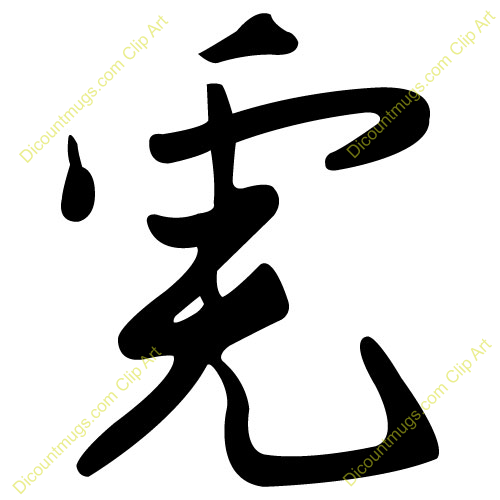
The art of calligraphy is widely practiced and revered in the East Asian civilizations that use or used Chinese characters. These include China, Japan, Korea, and to a lesser extent, Vietnam. In addition to being an art form in its own right, calligraphy has also influenced ink and wash painting, which is accomplished using similar tools and techniques. The East Asian tradition of calligraphy originated and developed from China, specifically the ink and brush writing of Chinese characters.

Friday, January 4, 2013

printable calligraphy alphabet


There are many free calligraphy printable alphabets 

Calligraphy is generally divided into two types: Western calligraphy and East Asian calligraphy. If you want to learn these two styles of calligraphy writing it is very simple and easy - you can learn just by following the tutorials that are available in calligraphy learning books or online. It is not difficult to learn calligraphy and even those with little or no coordination can master this art.


Sunday, December 30, 2012

fancy calligraphy alphabet


Calligraphic is a fairly straightforward, simple calligraphic font that was based on the 6th grade curriculum book from Bob Jones University©, with which EFI is not associated. It is intended to give 6th graders something fun to do. Looks pretty nice on its own, though, so we included it for you. 

Saturday, December 22, 2012

History of Calligraphy


The word Calligraphy comes from the Greek word Kalos, meaning beautiful and Grapho, to write; thus, Calligraphy means Beautiful Writing.Calligraphy was virtually eliminated when the demand for more books necessitated the invention of printing and other modern writing tools.  “Handwriting” lost its place as an art form.Finally, in the beginning of the 20th Century, interest in Calligraphy was rekindled and its popularity continues to grow. 


Thursday, December 20, 2012

calligraphy letter J


Calligraphy is a whole lot of fun and can be enjoyed by young and old alike. I have had students as young as 7 years old and as old as...(well, maybe I"d better leave that one unsaid!). It is one of the most enjoyable skills that a person can acquire. 


Monday, December 17, 2012

Armenian Alphabet


From the radiant Armenian Highlands of sacred Mount Ararat to the dark killing grounds of Ottoman Turkey, the Armenian people have endured extreme rites of passage.  An ancient nation, few present-day states can boast of having a developed civilization as far back as the 1st millennium B.C.   
 It is now shown to be a prehistoric observatory, which astronomers date to either the 3rd or 5th millennium BC, predating England’s Stonehenge.


Calligraphy Armenian tradition


Two years ago, I received a request from the editor of the “Encyclopedia of World Calligraphy” to contribute to an upcoming edition by drawing samples of Armenian script. I was told that they needed all four major scripts executed with sequence of strokes (the direction of writing). For over three months, I spent my nights drawing letters, digging out anything I could find on my bookshelf, only to discover that calligraphy as a discipline was a rare find in the rich legacy of Armenian culture. How could it be, I asked myself, that we have so little written about it? We have studies of paleography (the science of writing) but practically nothing on calligraphy (the art of writing).

calligraphy in the Armenian tradition is certainly one of the least explored and studied areas. What was different about us?